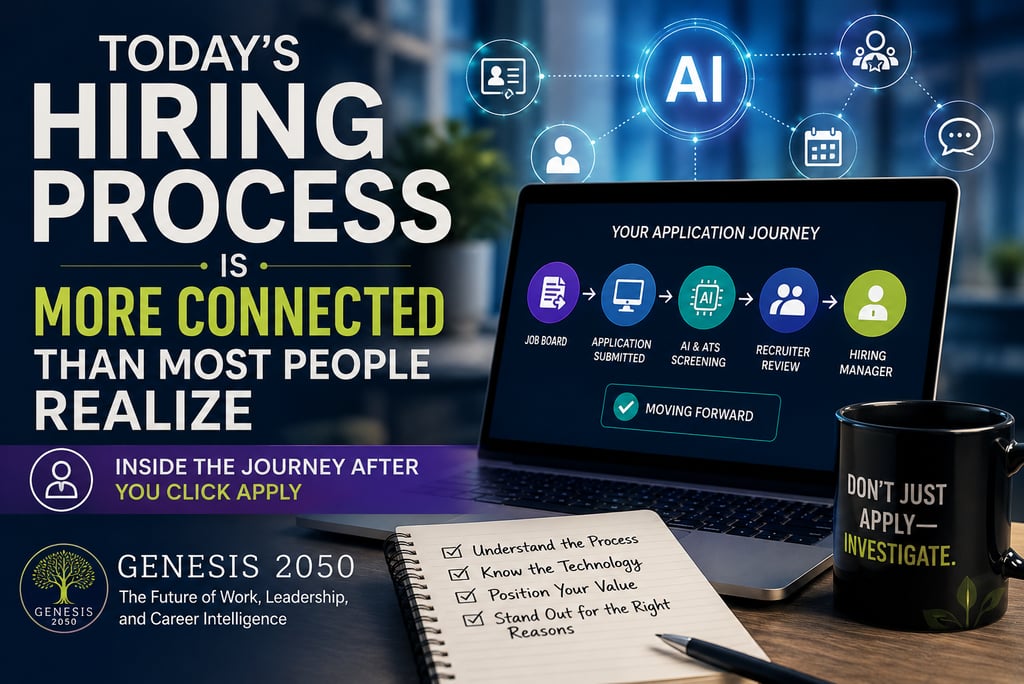
Today's Hiring Process Is More Connected Than Most People Realize
Think your resume goes straight to a recruiter? Think again. Discover how AI, applicant tracking systems (ATS), and modern hiring platforms work together behind the scenes—and what every job seeker should understand before clicking Apply.
FUTURE OF WORKHIRINGEASY APPLYAI
Lori Pritchard, BSW, MHA
7/9/20264 min read
If you've applied for a job in the past few years, you may have noticed that the hiring process feels different. Applications move through multiple stages, interviews are often scheduled automatically, and communication may come through email, text message, or online recruiting portals.
That's because many organizations no longer rely on a single piece of hiring software. Instead, they use connected talent acquisition platforms that bring multiple recruiting functions together into one system.
For example, iCIMS Talent Cloud describes its platform as an enterprise solution that combines applicant tracking, candidate relationship management, AI-assisted recruiting, interview scheduling, onboarding, and workforce analytics into a single hiring ecosystem.
Other enterprise platforms have taken a similar approach. Greenhouse Recruiting, for example, emphasizes building an integrated hiring platform that connects recruiting teams with hundreds of HR, payroll, communication, and assessment tools to support the entire hiring lifecycle.
Many of these platforms also serve as the digital delivery system for your application. Rather than sending a résumé directly to a recruiter's inbox, your application often enters an enterprise hiring platform where it can be organized, routed, evaluated, and shared throughout different stages of the hiring process. Understanding that journey helps explain why today's application experience feels very different from simply emailing a résumé to Human Resources.
For employers, these connected systems reduce administrative work and help recruiting teams manage high-volume hiring more efficiently.
For job seekers, however, they represent something equally important.
Your application is no longer moving through a series of disconnected steps. Instead, it's entering a coordinated hiring process where information can flow from one stage to the next, helping recruiters, hiring managers, and HR teams work from the same candidate record.
That doesn't mean technology makes the hiring decision.
It means the hiring process itself has become more connected, more data-driven, and more efficient than many people realize.
Understanding that bigger picture can help explain why the job search experience feels different today than it did even a decade ago.
Prefer to watch instead of read?
This article accompanies this week's Genesis 2050 video, "What Really Happens After You Click Apply." In the video, I walk you through the journey your application takes after you submit it and explain how modern hiring platforms, AI, and recruiters work together behind the scenes.
🎥 Watch the full video here: (YouTube link)
What This Means for Today's Job Seeker
For employers, modern hiring technology promises greater efficiency.
For many job seekers, however, the experience often feels very different.
If you've ever submitted dozens of applications only to receive an automated rejection within hours—or sometimes within minutes—you're not alone. Many professionals describe today's hiring process as faster, less personal, and more difficult to understand than it was just a few years ago.
Part of that frustration comes from not knowing what happens after clicking "Apply." When candidates don't understand how applications are organized, reviewed, or prioritized, every rejection can feel personal—even when the decision may have been influenced by automated workflows, employer-defined screening criteria, or the sheer volume of applications.
Recent industry research has shown that employers are investing heavily in AI-assisted hiring while candidates are adopting AI tools of their own to improve résumés and applications. As both sides embrace technology, the hiring process is becoming increasingly digital, creating new opportunities—but also new challenges—for everyone involved. (iCIMS & Aptitude Research report.)
At the same time, enterprise recruiting platforms from companies such as Oracle, iCIMS, Workday, and Greenhouse continue expanding their capabilities, helping organizations manage recruiting, onboarding, workforce planning, and other stages of the employment lifecycle.(Oracle HCM)
For job seekers, this creates an important reality.
The question is no longer simply,
"Am I qualified?"
In many organizations, your first interaction isn't with a recruiter—it's with a digital hiring process designed to help manage information before human review begins.
Increasingly, it's also,
"Does my experience clearly communicate that I'm qualified in a way the hiring process can recognize?"
That distinction matters.
Because being qualified and being recognized as qualified are not always the same thing.
Understanding that difference doesn't guarantee an interview.
But it does help explain why so many capable professionals are questioning a hiring process that feels faster, more automated, and less transparent than ever before.
In the companion video, I illustrate this process visually so you can actually see how an application moves from the job board through enterprise hiring systems before it reaches a recruiter.
Preparing for the Future of Work
If there's one lesson to take away from today's hiring environment, it's this:
The hiring process has changed, and successful job seekers need to change with it.
That doesn't mean trying to outsmart artificial intelligence or searching for shortcuts to "beat the ATS."
It means understanding how modern hiring works and presenting yourself in a way that clearly communicates your skills, experience, and potential.
Take time to tailor your résumé to the position you're applying for. Keep your LinkedIn profile current. Highlight measurable accomplishments instead of simply listing job duties. Continue learning new skills, and remember that networking and professional relationships remain just as important as submitting online applications.
Top 10 in Demand Skills by 2035
Most importantly, don't let technology discourage you.
Every hiring system is different. Every employer defines its own hiring process, screening criteria, and evaluation methods. Some organizations rely heavily on technology, while others place greater emphasis on recruiter review and personal interaction.
That's why one of the most valuable career skills today isn't simply writing a better résumé.
It's understanding the hiring system you're trying to enter.
The more you understand how that system works, the better prepared you'll be to position yourself for opportunities that align with your experience, your goals, and your future.
Conclusion
The world of work is changing faster than ever.
Artificial intelligence, enterprise hiring platforms, and digital recruiting tools are reshaping how organizations identify and evaluate talent. Those changes create new opportunities—but they also create new challenges for workers trying to navigate a hiring process that often feels unfamiliar.
The good news is that knowledge creates confidence.
The more you understand today's hiring systems, the better equipped you'll be to adapt, make informed career decisions, and compete in an evolving job market.
This is exactly why I created the Genesis 2050 series—to help professionals understand not just where work is going, but how to prepare for it.
Because in today's job market,
Don't Just Apply—Investigate.
If you found this article helpful, be sure to watch this week's Genesis 2050 episode:
🎥 "What Really Happens After You Click Apply"
There you'll see the hiring journey step-by-step with diagrams and examples that complement what you've just read. YouTube Video