Qualified but Invisible
The hiring process has changed. Discover the hidden barriers standing between qualified candidates and interview opportunities.
CAREERHIRINGAIFUTURE OF WORK
Lori Pritchard
6/13/20262 min read
Why Qualified Professionals Are Being Overlooked in Today's Job Market
You've updated your resume.
You've applied for dozens—maybe hundreds—of positions.
You have the experience, the skills, and the qualifications.
Yet the interviews never come.
Many job seekers assume the problem is their resume, their age, their industry, or even their abilities. While those factors can matter, they often miss a larger reality:
The hiring process itself has changed.
Today's job market operates differently than it did even a few years ago, and many qualified professionals are still using strategies designed for a different era.
The Hidden Shift Most Job Seekers Don't See
For decades, the job search process was relatively straightforward.
Employers posted openings.
Applicants submitted resumes.
Hiring managers reviewed candidates.
Today, technology sits between employers and applicants.
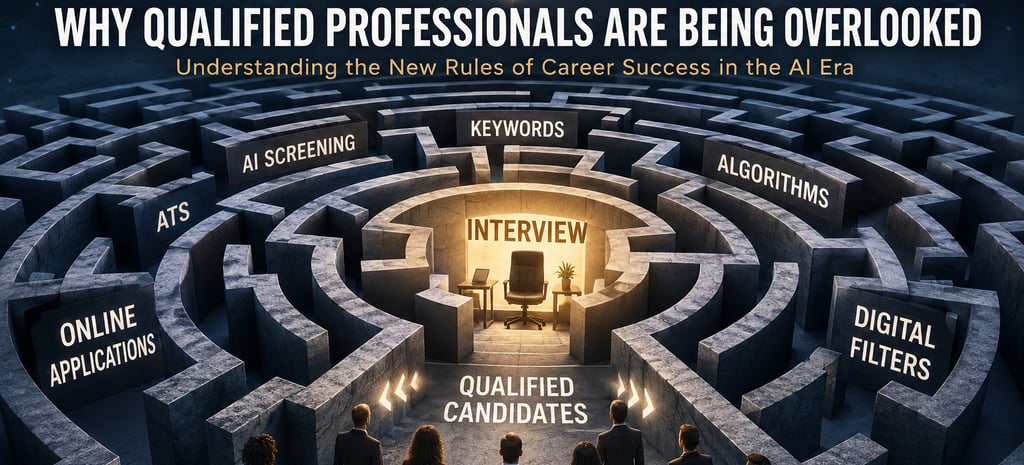
Applicant Tracking Systems, AI-powered screening tools, automated keyword matching, and digital recruiting platforms often determine who gets seen and who gets ignored before a human ever reviews an application.
Being qualified is no longer enough.
You must also be visible.
Why More Applications Often Produce Worse Results
When job seekers don't receive responses, many react by submitting even more applications.
The logic seems reasonable:
"If 20 applications didn't work, maybe 100 will."
Unfortunately, this approach can create frustration without improving results.
More applications do not automatically increase visibility.
In many cases, they simply increase the number of times a candidate enters the same filtering systems.
The Rise of Relationship-Based Hiring
Despite advances in technology, one thing has not changed:
People still hire people.
Research consistently shows that referrals, networking connections, and professional relationships continue to play a significant role in hiring decisions.
The challenge is that many professionals spend 95% of their effort applying online and only 5% building relationships.
The most successful candidates often reverse that formula.
The AI Opportunity Most Professionals Are Missing
While many people fear AI, others are quietly using it to strengthen their job search efforts.
The difference is not whether AI is used.
The difference is how it is used.
AI can help candidates understand job descriptions, identify skill gaps, prepare for interviews, and improve professional communication.
Used correctly, it becomes an advantage.
Used incorrectly, it can create generic applications that blend into the crowd.
The New Rules of Getting Noticed
Today's job market rewards professionals who:
Build visibility
Create meaningful connections
Adapt to changing technology
Demonstrate value clearly
Position themselves strategically
The good news is that these are learnable skills.
What's Next?
Understanding why the job market has changed is only the first step.
The next question is:
What can you do about it this week?
In my latest YouTube video, I share three practical actions you can take immediately to increase your visibility, strengthen your professional network, and use AI more effectively in your job search.
Watch the video here:
Applied to 100 Jobs? No Interviews? 3 Changes You Need to Make