
ATS-Friendly Resume: Does the White Text Hack Work?
Does hiding keywords in white text help your resume pass an ATS? Learn why this popular hack can backfire and what makes a resume genuinely ATS-friendly.
CAREERHIRINGAI
Lori Pritchard BSW, MHS
7/18/20264 min read
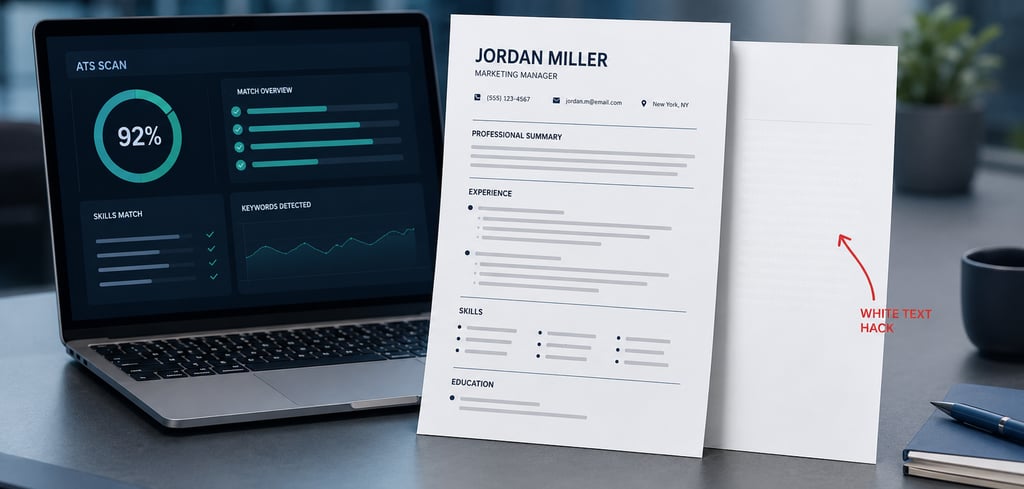
But does the white text resume hack actually work?
An ATS-friendly resume should help an applicant tracking system accurately read and organize your qualifications. But some job seekers are being told that they can improve their chances by hiding keywords in white text.
What Is the White Text Resume Hack?
The advice sounds simple: copy important words—or even the entire job description—into your resume, change the font to white, and make the text invisible. The applicant tracking system will supposedly read those hidden keywords, increase your match score, and move your application closer to an interview.
The white text hack involves hiding keywords from human readers while leaving them embedded in the digital resume.
Some applicants hide a list of skills. Others paste the entire job description into a margin or at the bottom of the document.
The strategy depends on one assumption: the more matching words the system finds, the better the applicant’s chances become.
That assumption oversimplifies how applicant tracking systems and hiring processes work.
The direct answer is no. Some systems may extract the hidden words, but that does not make the resume genuinely ATS-friendly. It may also create credibility problems if the tactic becomes visible during the hiring process.
Many job seekers use online resume scanners that compare their resume with a job description and produce a match percentage.
Why Do Applicants Believe It Works?
However, an outside resume scanner does not know:
It may.
How the employer configured its applicant tracking system
Which qualifications are mandatory
Which searches the recruiter will perform
Whether knockout questions are being used
Whether an internal candidate is already under consideration
Social-media testimonials also make the hack seem proven.
Someone may say, “I added hidden keywords and received an interview.” But that does not prove the white text caused the result. The applicant may also have improved the visible resume, applied earlier, chosen a better-fitting position, or entered a smaller applicant pool.
A result that happens after using a hack is not necessarily a result caused by the hack.
Can an ATS Detect Hidden White Text?
When adding keywords raises the score, applicants may assume the employer’s ATS will react the same way.
But extraction is not the same as advancement.
When adding keywords raises the score, applicants may assume the employer’s ATS will react the same way.
Applicant tracking systems do not all use the same features, configurations, or screening rules.
A system reading a keyword does not prove that the employer will:
Increase the applicant’s ranking
Consider the applicant qualified
Move the application forward
Select the candidate for an interview
When adding keywords raises the score, applicants may assume the employer’s ATS will react the same way.
A hidden keyword may exist in the file, but its presence does not prove that the candidate has performed the work.
A recruiter may view a parsed version of the resume inside the applicant tracking system rather than seeing only the original document.
Can Recruiters See the Hidden Keywords?
Text that was invisible against a white background may become visible when it is:
But the larger problem is not simply whether the recruiter sees the hidden words.
Extracted into plain text
Copied and pasted
Reformatted
Displayed inside the recruiter’s system
Suppose the resume contains terms such as “financial forecasting,” “employee relations,” or “healthcare compliance,” but the visible work history contains no evidence supporting those qualifications.
Even when the hidden text is not immediately discovered, the unsupported claim may become apparent during an interview, skills assessment, reference check, or employment verification.
The applicant may be able to hide the words, but not the absence of experience behind them.
The white text hack creates an unequal risk-to-reward equation.
Can White Text Harm an Application?
The potential benefit is uncertain. The risks are more concrete.
There is no reliable guarantee that hidden text will improve an applicant’s position across different ATS platforms and employers.
White text may:
The time spent hiding words could instead be used to clarify accomplishments, demonstrate transferable skills, or connect experience more directly to the employer’s needs.
Create concerns about judgment or honesty
Insert irrelevant language into the parsed resume
Produce unsupported qualifications
Make the application appear intentionally manipulative
Distract the applicant from improving the visible resume
A strong ATS resume should be readable by the software and persuasive to the recruiter.
What Makes a Resume ATS-Friendly?
A genuinely ATS-friendly resume does three things well.
There is no reliable guarantee that hidden text will improve an applicant’s position across different ATS platforms and employers.
Use Relevant Terminology
Skills
Responsibilities
Systems
Certifications
Industry terms
Required experience
Review the job posting and identify the most important:
Use the employer’s language when it truthfully describes your background.
This helps your resume appear in relevant recruiter searches without misrepresenting your qualifications.
Important resume keywords should appear where they make sense, including:
Place Keywords Naturally
They should not appear as an invisible list or a copied block from the job description.
The professional summary
The skills section
The employment history
Accomplishment statements
A keyword becomes persuasive when it is connected to evidence.
Prove the Keyword
Managed revenue-cycle operations across five outpatient locations and reduced unresolved denials by 18%.
Keyword only:
Supported evidence:
Revenue-cycle management
The second example demonstrates scope, responsibility, and results.
That evidence remains valuable whether the resume is being parsed by software, searched by a recruiter, reviewed by a hiring manager, or discussed during an interview.
Hidden white text may place additional words inside a resume, but that does not make it genuinely ATS-friendly.
The Final Verdict
An ATS-friendly resume:
The goal is not to trick an applicant tracking system into finding words.
Uses accurate terminology
Follows a clear, readable structure
Connects skills to credible experience
Can be accurately processed by technology
Can be believed when a real person reads it
The goal is to make your legitimate qualifications searchable, understandable, and believable.
The white text trick is only one of six ATS myths affecting job seekers. Watch “6 ATS Myths That Are Killing Your Interview Chances” to learn why keyword stuffing, exact job-title matching, PDF fears, secret resume scores, and other popular claims may weaken your job-search strategy.